General Event Overview
- Event Title: New challenges for Dirac operators
- Date: 1 – 5 June 2026
- Location: Universidad Carlos III de Madrid, Spain
- Sponsoring/Organizing Entity: COST Action CA24122 (multiscale Stochastics, Patterns, and Analysis of Combinatorial Environments — mSPACE)
- Official Website: Dirac 2026 Madrid
Workshop Description and Objectives
This five-day international workshop provided a highly collaborative forum for discussing recent advancements and emerging trajectories in the analysis and spectral theory of Dirac-type operators.
The primary goal was to foster an exchange of ideas and current challenges among global experts and early-career researchers sharing common interests in mathematical physics.
The scientific scope of the conference aligned with the core research pillars of the mSPACE COST Action, focusing on:
- Spectral properties of Dirac operators, including non-self-adjoint problems.
- Boundary value problems, transmission shell interactions, and asymptotic analysis.
- The intricate interplay between geometry and spectral theory via Faber-Krahn inequalities.
- Concrete applications in relativistic Quantum Mechanics, solid-state Physics, graphene, and nonlinear dynamics.
Participation and Leadership of COST Action Members
The event demonstrated robust integration with the mSPACE network, drawing significant leadership from Action members who served across organizing committees, chaired scientific sessions, and delivered core presentations.
Committees & Organization
The scientific integrity and logistical success of the workshop were steered directly by mSPACE members:
- Organizing Committee: Borbala Gerhat (Institute of Science and Technology Austria)
- Scientific Committee: Lucrezia Cossetti (Universidad del País Vasco), David Krejcirík (Czech Technical University in Prague), and Petr Siegl (Graz University of Technology).
Sessions Chaired by Action Members
mSPACE members actively structured the scientific discourse by serving as session chairs throughout the week:
- Vincent Bruneau chaired the Thursday morning session on spectral enclosures and expansions.
- Albert Mas chaired the final Friday session, overseeing the poster award lectures and concluding talks
Invited Lectures by Action Members
Several COST Action members delivered core invited lectures, driving the primary scientific contributions of the event:
- Thomas Ourmières-Bonafos (Aix-Marseille Université, I2M ): “Spectrum of the Dirac operator in thin waveguides”
- Vincent Bruneau (Université de Bordeaux, IMB): “A Poincaré-Steklov map for Dirac operators”
- Albert Mas (Universitat Politècnica de Catalunya): “Spectral inequalities for quantum dot Dirac operators”
- Konstantin Pankrashkin (University of Oldenburg): “MIT bag operator in non-smooth convex domains”
- William Borrelli (Politecnico di Milano): “Dirac solitons in one-dimensional cubic NLS”
Summary of Main Activities and Scientific Highlights
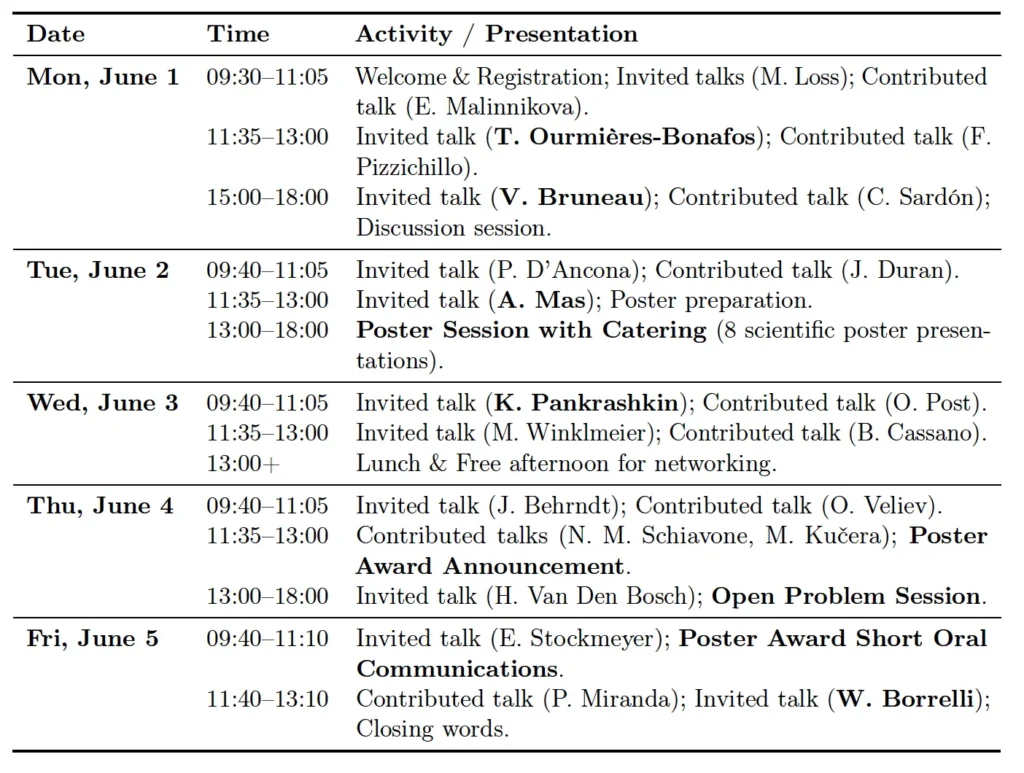
The conference program featured a balanced mix of 11 invited talks, 10 contributed talks, an interactive poster session, and an active open problem forum, as outlined in the official web page and the book of abstracts.
Scientific Programme Overview
Special Research Sessions and Outcomes
Open Problem Session
An essential highlight of the workshop designed to map out future network-driven research was the Open Problem Session held on Thursday afternoon. This session provided an active platform for participants to pitch unresolved questions to the audience, fostering spontaneous debate. COST Action members were pivotal in anchoring this session: Albert Mas and Thomas Ourmières-Bonafos presented critical open problems alongside the early career researcher Eric Trébuchon.
Poster Session and Young Researcher Awards
To support the COST priority of empowering Young Researchers and Innovators (YRIs), a dedicated Poster Session showcasing 8 specialized projects was held on Tuesday. The session concluded with a community vote for the best scientific posters. Reflecting the high standard of mentorship within the network’s ecosystem, the two top-awarded researchers were granted oral communication slots on the final morning of the conference